Yesterday I wrote about skydiver Luke Aikins and his 25,000 foot jump without a parachute. At the time, I said that there had to be a YouTube video coming that would show the entire proceedings, and I was right. You can watch the entire spectacle in the clip below, which is as scary as you would expect, even knowing the outcome. It will also give you more respect for Aikins skills as a skydiver as he maneuvers into a relatively small net to arrest his fall. Amazing stuff all around.
Selasa, 02 Agustus 2016

Olly and George first tried to paddle across the Dance Floor a few weeks back. They set out from the coast of Iceland on July 23 on what they knew was the toughest leg of their entire journey. But after spending 36 hours on the open sea they received word that bad weather was heading their way. The coast guard advised that they turn back as conditions did not look good.
Fortunately, they were able to hitch a ride on a passing fishing boat and made it back to shore safe and sound. Since then, they've been working on that same fishing boat, earning their keep while they waited for the weather to improve. At long last they've gotten toe okay to proceed, and the forecast looks promising. So, yesterday they returned to the water have has started to cross this treacherous stretch of open water once again.
The boys now face 12 days of living in their kayak as they make their way to the Faroe Islands. During that time they will eat, sleep, and paddle in their boat, completely focused on making progress towards their goal. They have now entered the most crucial stage of this journey, and the next week and a half could be incredibly difficult and dangerous.
As of today, the weather seems to have turned in their favor. The wind is at their back and they are making good progress. In fact, according to their dispatches they have already covered more ground in 24 hours than they did in the first 36 hours out on the Dance Floor. They won't be able to maintain that speed of course, but it is helping to put them back on track. Hopefully the good luck will continue and they'll complete the crossing safely.
Good luck to Olly and George. Follow their progress here.
Senin, 01 Agustus 2016
Galicia is an independent region on the northwest coast of Spain that is known for its dramatic landscapes, sweeping vistas, and breathtaking slopes. Outsiders aren't a common site in this part of the world, but those who do make the trip are treated to some amazing settings, many of which remain mostly untouched by man. In this video, we travel into this land of the lost to witness its beauty for ourselves. I think that you'll agree that the results are nothing short of spectacular.
Galicia, Land of the Lost from Daniel Almeida Visuals on Vimeo.
This short, but very sweet, video takes us to Kenya, where a couple of ingenious travelers came up with the idea of strapping a GoPro camera to a radio controlled car, essentially turning it into a makeshift, ground-based drone. The results were pretty spectacular, as they managed to capture some of the most iconic wildlife of the Masai Mara up close and personal.

After spending two days in Mongolia's capital city of Ulaanbaatar, then the better part of a day traveling to the remote town of Ulgii, followed by another full day in SUV's driving dirt roads just to reach the start of our journey, I think it was safe to say that my companions and I were ready to truly get our adventure started. We had all come to Mongolia to go horseback riding through the Altai Tavn Bogd National Park with Tusker Trail, one of the best adventure travel outfitters in the entire world. But, we had no idea how much of an adventure we would have before even climbing into the saddle for the first time. It was all part of the plan – and part of the fun – of course, but after camping for two nights on the edge of the spectacularly beautiful Khoton Nuur lake, it was time to get riding at long last.
After a hardy breakfast, we broke camp and began preparing for the day ahead. Our first full day in the saddle would be roughly 5-6 hours in length, and cover 22 km (13 miles). Not a bad start to the trip, giving all of us a chance to get comfortable on horseback before pushing into the longer days that would lie ahead.
One of the best parts of Tusker's Mongolia itinerary is that you can choose to either ride the trails, hike the route, or mix it up and do both. Most of travelers had come to ride – after all we were exploring the home of arguably the greatest horsemen that have ever lived. But some felt more comfortable on their own two feet, and each day they would head out with a trekking guide just ahead of those who were on horseback. I personally wanted to experience both riding and hiking, so I alternated my time in the saddle and on foot for parts of the journey. Ultimately, I would end up riding much more than hiking, but for the most part I was glad to get the chance to see this beautiful country in either fashion.
On our first day of riding there was a nervous anticipation in the air. Everyone was eager to get started, but most of us had never spent a full day on horseback before, and some had never ridden at all. This brought a sense of uncertainty about what to expect, as a horse certainly has a mind of its own and can do unpredictable things at times. This happened more than once throughout the trip, with our mounts occasionally stumbling, getting spooked and acting erratically, or being stubborn enough to do what they wanted, despite the best efforts of their riders. In my case, I even had my horse decide to lay down in the grass while I was still in the saddle. Fortunately I was able to dismount without a significant loss to my dignity, but as a somewhat inexperienced rider myself, it was a lesson learned to be sure.
For the most part though, the horses were well behaved, extremely sure-footed, and easy to ride. After a day or two most of the riders became comfortable with their mounts, and the trust grew between both the animal and the person on its back. In fact, anyone who joins this Tusker excursion will most certainly come home a better rider, and by the end of the trip we were all doing things in the saddle that would have seemed unlikely at the beginning.

While our travels were conducted both on foot and horseback, the logistics of moving our camp from one location to another was handled by camel train. The two-humped Bacterian camels that are common in Mongolia seem well suited for life on the Steppe, and served as incredibly strong pack animals for our expedition into the Altai Mountains. Each day, our team would load a wide variety of bags, packs, and containers onto the backs of the camels, and off they'd go to our next destination. Often times they would pass us on the trail each day while we were enjoying lunch in some idyllic setting. More often then not, they would arrive at the new campsite well before we did, and we'd find our tents awaiting us. On occasion, the travelers themselves would be a bit quicker, and we'd all lend a hand in helping set up camp that evening. The entire operation, while time consuming, ran very smoothly, and was a testament to how well staffed and organized Tusker truly is. It isn't easy shepherding 13 clients around the wilds of Mongolia, let alone keeping them well fed, protected from the elements, and comfortable along the way too.
Our days out on the trail generally passed in this fashion. We'd break camp and begin riding (or trekking!) by mid-morning, stopping for breaks on occasion to allow the horses to rest and the riders to stretch their legs. Around noon or 1:00 PM each day, we'd find a comfortable, and usually very beautiful, place to stop for lunch, which was always simple, but very tasty affair, catered by the Tusker guides and delivered by a lone camel charged with sticking with the travelers throughout the course of the day. In the afternoon, we'd tend to press on a bit longer in the saddle, reaching our next campsite by early evening where we would enjoy a little reprieve from the trail, swap stories of previous adventures, and relax in the spacious dining tents. Snacks, drinks, and dinner were always a very communal affair, with the entire group laughing, getting to know one another, and developing deep bonds that would forever link them to one another. It was a thoroughly enjoyable and engaging experience.

Within a day or two we fell into a good rhythm on the trail. The days were filled by riding and trekking in one of Mongolia's most spectacular outdoor playground, while the nights began with increasing camaraderie amongst the travelers, and ended with by crawling into a warm sleeping bag to get a good night's sleep in a quiet, peaceful setting. It was a wonderful was to explore a place that few foreign visitors get the chance to ever see. A place were nomads still roam as they have done for generations, and horses outnumber people by a considerable margin. There aren't many other places on Earth like that anymore, which is just one of the many reasons this trip was so special.
More to come in the next installment.

The historic jump took place in the California desert on Saturday evening, which is when years of planning and months of training came together at long last. The very experienced skydiver used all of the skills he gained on more than 18,000 previous jumps to maneuver himself through the air and land on a 10,000 sq. foot net, which caught him perfectly, preventing Aikins from smashing into the ground. At that moment, he became the first person in history to jump from an airplane without a parachute, and land safely.
In the minutes leading up to that dangerous landing, Aikins – along with three other support skydivers who were wearing chutes – jumped from an aircraft and began drifting back to Earth. Luke wore an oxygen mask until he dropped below the 18,000 foot (5486 meter) mark, at which time he proceeded to fall without any kind of additional aid. He had to keep his wits about him at all times, and control his descent as best he could, in order to land on his mark. The net, which is roughly one third of the size of football field, was specifically designed and built to catch him just right, preventing any kind of injury. But, in order to hit it the daredevil had to be very precise in his approach. Fortunately, he was.
Just prior to making the jump it was announced that Aikin had been required to wear a parachute, although he vowed not to open it. It is unclear where this requirement came from, and it flew in the face of the entire plan, casting a brief shadow over the proceedings. Luke had been planning to make this jump sans chute for more than two years, and we even told you about his jump here on The Adventure Blog more than a year ago. But once he was airborne the requirement was reportedly lifted, and he was free to make the jump as he had originally intended.
As already mentioned, Aikin is an incredibly experienced skydiver. In addition to the 18,000+ jumps he's already made, he also is a consultant to the U.S. military, served as a stuntman, and even worked on Felix Baumgartner's record setting jump from the edge of space a few years back. In other words, if anyone had the skills necessary to make this leap, it was Luke and very few other people should even consider it. Hopefully this doesn't start a trend of more people trying to push the envelope in the skydiving department, which could end in tragic accidents.
That said, this is another stunt that I'm eager to see the YouTube video for. Hopefully we'll get something released int he next few days. It will definitely be interesting to watch the entire fall and see how it all unfolded.
Congratulations to Luke on accomplishing this feat. What an amazing, daring, and crazy stunt to pull off.

According to Spanish website Desnivel.com, a three-man team consisting of Oscar Cadiach, Manolo Gonzalez, and a local climber named Sahib are in the midst of a final summit push at this very moment. The trio left Base Camp and reached Camp 2 on Saturday, moved up to Camp 3 on Sunday, and are now in position to complete their ascent today.
The weather in the region is reportedly good, and should remain so for another day or two, but as always in the Karakoram, the conditions on the mountain can be fickle and change quickly. Still, the climbers seem poised to complete their expedition, and potential cap what has been a long and difficult season in the mountains.
If Cadiach is able to complete this climb successfully it would be his final 8000-meter peak. Having climbed all of the other 13 mountains of that height, only BP remained on his hit list. Even more impressive, he's managed to climb each of them without the use of bottled oxygen, putting him in very rare company indeed.
We'll keep an eye on the team's progress and report any updates as they come in. Hopefully they'll get up and down the mountain safely, whether they reach the summit or not.
Meanwhile, over on the Gasherbrums there are still a few teams still in place as well. I haven't heard any updates on their progress in recent days, so it is unclear of their current status.
More to come soon.
Jumat, 29 Juli 2016
We'll wrap up the week with an all-too-brief visit to the Scottish Highlands. This video was shot on 1300 mile long trip around Scotland that began in Glasgow, ran to the Isle of Skye and back again. Stops along the way included Loch Lomond, Loch Ness and Glencoe, with the results being nothing short of spectacular. This is a beautiful and enchanting part of the world, and a place that should be on every traveler's bucket list. I hope you enjoy.
Highlands. from Joren de Jager on Vimeo.
At the age of 19, pro kayaker Aniol Serrasolses became the first person to drop over the 115-foot Puma falls in Chile. The impact of that drop was so strong that it actually ejected him from his boat. Recently, he decided to go back and give it another go, this time looking to paddle a clean line. This video takes us to this extremely difficult and technical waterfall with Aniol as he takes the plunge once again.

On our third day in country we caught an early afternoon flight for the town of Ulgii, which is the capital of the Bayan-Ölgii Aimag province. The city is home to about 28,000 people, and would serve as the true launching point of our journey, which would eventually take us into the heart of the remote and spectacular Altai Tavn Bogd National Park that falls on the border with China and Russia.
When we arrived in Ulaanbaatar, my fellow travelers and I were warned about something called the "Genghis Factor." Much like when you visit Africa and everything runs on "Africa Time," there are often factors that are beyond your control that can keep everything from running on a tight, efficient schedule. That means that when a flight is scheduled to leave at 2:00 PM in the afternoon, don't be too concerned if it doesn't actually begin an hour or more later. That's just the way things roll sometimes in Mongolia, and the Genghis Factor isn't just confined to flights. It can impact all kinds of other things as well, and it is best to just accept it, be patient, and roll with it while you're there.
That happened to be the case with our flight to Ulgii, which was about three hours in length with a brief stop over to pick up fuel and passengers at an intermediate point along the way. Ulgii was starkly different than Ulaanbaatar in that it was much more quiet and relaxed. The rural town has plenty of restaurants, markets, and shops for visitors, but it is definitely far from the hustle and bustle of the capital.
Our accommodations for our night Ulgii were at a local Ger camp, where we stayed in the traditional yurts that are common amongst the nomadic people that inhabit the remote regions of Mongolia. The gers found there were basic and comfortable, but would seem like palaces once we struck out for the Altai Mountains. We enjoyed one last night's sleep in a bed before we'd be relegated to tents and sleeping bags for the majority of the trip.

We made severals stops while en route to our first campsite, including visiting a Mongolian army base where we all checked in with the local authorities. But the most interesting stop was early on in the journey, when we met one of the legendary eagle hunters that call the region home. These hardy men use specially trained eagles to hunt down foxes that are found in the countryside. That activity typically takes place in the winter, and since we were visiting in the summer no one was heading out on a hunt. Still, were were able to not only get to see one of the hunters in his traditional gear, but also meet one of the enormous birds he uses for this task.
Our destination for the first day in the wild was a lake called Khoton Nuur. We would camp along the banks of that body of water for two days, allowing us to get accustomed to life in pastoral Mongolia while also meeting the horses (and horsemen!) who would see us through this adventure. But reaching Khoton Nuur would not be easy. It involved navigating narrow dirt roads for hours on end with only our guides' knowledge of the way to get us there safely. Along the way we would cross through rivers that were swollen with the summer melt-off following a snow winter and rainy spring. At one point, one of the vehicles even got bogged down in the middle of the water and had to be pulled out by another Land Cruiser. But eventually, after about six or seven hours of driving, we reached our destination, and it certainly did not disappoint.
Camping along the banks of the lake we could spot the Altai Mountains off int he distance. Snow glistened from their high peaks, while the tranquil waters of Khoton Nuur lapped lazily at the shore. The campsite sat on a wide open grassland, while the ger of a local family sat on a hill overlooking the proceedings. We all agreed that the site would be an amazing place to spend the first few nights in the field, and was an amazing scenic way to begin the first stage or our expedition into the mountains.

After a good night's sleep along the banks of Khoton Nuur, we were all eager to get started the next day. Tusker's Mongolia itinerary is mainly aimed at exploring the Altai Tavn Bogd National Park by horseback, although clients can elect to hike the route as well. Most would choose one or the other over the course of the two-week trip, but a few of us mixed things up, sometimes riding and sometimes trekking depending on how we felt on any given day. This flexibility was nice as well, as not everyone was completely comfortable on a horse, much preferring to cover the distance under their own power instead.
On our second day along the lake we were introduced to the mounts that would be our companions throughout the trip. The family ger that overlooked our campsite was home to a group of exceptional horsemen who have carved out a living on the steppe for generations. They also happen to have a large herd of horses that have been born and bred to deal with the challenges that are found there. On that morning, they brought those horses to our camp, were we discovered that each of us had been assigned a mount that was suited for our physical stature and personality. My particular horse was a strong, sturdy, and sure-footed animal who tended to start out slow in the morning, lagging behind the group, but would have a little extra skip in his step later in the day. That suited me just fine, because I often feel about the same.
That morning we had a nice orientation ride with our horses, taking them out on an easy trail that allowed us to get comfortable with one another. It didn't take long to discover that these creatures knew their way around quite nicely, and were adept at carrying their riders safely from one destination to the next. When paired with a comfortable Australian-style saddle, it took only minutes for me to feel at home on the back of my steed, and as the days past my skill and confidence only grew as well.
After riding for a couple of hours we found ourselves approaching the family ger. The lead horseman – a large good natured man by the name of Karbi – invited us all to dismount and come inside their home. It was our first opportunity to see the traditional yurt as an actual nomadic family lived in it, and it was one of the early highlights of the trip. Inside, we found snacks that included fried bread, local cheeses, and various other snacks. We were also offered milk-tea, which was graciously accepted.

Mongol tradition says that the nomads won't turn away even strangers when they show up at their door. Their sense of hospitality is such that they will extend every courtesy to anyone that approaches. We saw that first-hand with the wonderful way the welcomed our group into the ger, offering food, conversation, and entertainment. At one point, Karbi pulled out a traditional stringed instrument from the steppe and proceeded to play and sing several songs. It was one of those priceless moments that only comes through travel when you find yourself at the perfect spot, at the perfect time.
After spending an hour or so enjoying the company of our new Mongol friends, we remounted our horses and made the brief ride back to our campsite. That would be all for the day, but we would be setting out early the next morning for our next destination, and on the first actual horse ride of the trip. While we had gotten acquainted with our mounts, and gotten to know the horsemen who would guide us some, the following day would be very different. It was time to begin the real trip, and I for one couldn't wait.
We camped one more night on the shores of Khoton Nuur, dreaming about the adventures to come. It had already been an amazing experience in Mongolia, and the real journey was only just about to get underway.
Stay tuned for more soon.

In the article, Motlagh travel to South America to explore the infamous Darién Gap, a 160 km (100 mile) long and 50 km (31 mile) wide stretch of land between Panama and Colombia that has remained remote, wild, and completely untamed for centuries. A haven for drug-runners and rebel guerrillas that are a part of the Revolutionary Armed Forces of Colombia (FARC), the Gap is known for its thick forests, murky swamplands, and twisting rivers that have all conspired with one another to make it a nearly impassable barrier for those traveling through what is best characterized as one of the most impenetrable places on Earth.
Just how challenging is it to cross the Gap? Consider this. The 30,000 km (19,000 mile) Pan American Highway runs nearly unbroken from Prudhoe Bay, Alaska, to Ushuaia, Argentina. I say mostly unbroken, because the one stretch of road that has never been completed is the section that is encompassed by the Darién Gap. That isn't to say that it can't be crossed however, as a 1960 expedition led by Land Rover proved. But it took the team 136 days to do so, covering an average of just 201 meters (220 yards) per hour.
Today, the Gap is also a major highway for smugglers looking to move immigrants across South America and north towards the U.S. Unfortunately, the way through the jungle is incredibly difficult, and many who enter never come out the other side. Over the years, explorers, journalists, researchers, and even adventure travelers have been swallowed up by the jungle there, never to be seen again. To say that this is one of the most dangerous places in the world would be an understatement, which is why it remains utterly fascinating as well.
Motlagh's story is a long, but incredibly interesting one, as he travels into the Gap to meet with FARC officials and to witness first hand the human trafficking that takes places there. His tale provides some perspective on this unique place, and just how difficult it is to travel through. It will also give you some idea why most people who travel along the Pan American Highway avoid it altogether, choosing to take a ferry around the jungle instead.
Read the entire story here and ponder what exactly it must be like in this dark, dangerous corner of our planet.
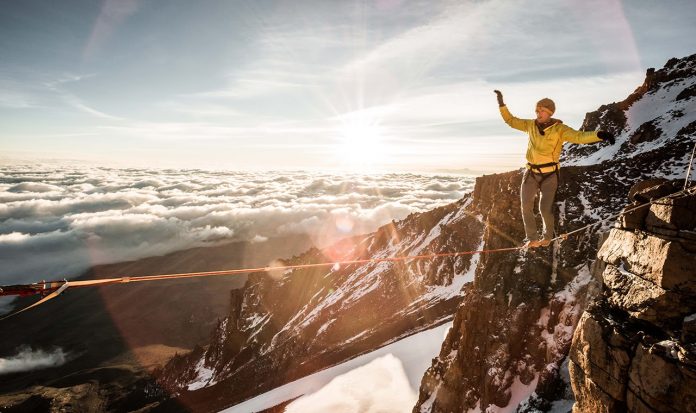
The 43-year old Siegrist set up a 21-meter length of line between two rock towers located at the Arrow Glacier Camp on Kili. The rope was set at a height of about 150 meters (492 feet), which left it exposed to the elements, which included a rise in gusting winds as the day went along. The weather forecast even included snow, which doesn't happen often on Kilimanjaro, but is possible when conditions are right just about any time of the year.
While slacklining balance is always a key, but at such high altitudes the body reacts slower to just about any physical challenge. That was the case here as well, as Siegrist found it difficult to make progress, even though he is very experienced at the sport. Eventually he did manage to cross the line successfully however, officially establishing the new record.
Slacklining has continued to grow in popularity in recent years, particularly as more people like Stephen put up impressive results in remote places. The previous record had been set last year in the Ladakh region of India. That mark was established by Hungarian climber Bence Kerekes who walked a line at about 5300 meters (17,388 ft). These records are most unofficial of course, as there is no real governing body to that oversees the claims.
While I'm not much of a slackliner myself, I can't help but be impressed by these attempts. One only needs to look at the image above to get a sense of great the view was where Siegrist was walking. I suspect we'll only continue to see these daredevils push the sport to new heights, both literally and figuratively. I'm sure someone is already planning such an attempt in the Himalaya.
Congrats to Stephen on his new record.
Kamis, 28 Juli 2016
This video takes us to the Canadian Rockies, where it attempts to give us a sense of scale by dropping humans into the landscape as a point of perspective. The results are often mind-blowing, as our brains begin to process just how immense the mountains, forests, rivers, and other natural wonders truly are there. I had a similar experience while visiting Alaska a few months back. The landscapes are of epic proportion, and it is impossible to convey that in a normal photograph. But this video does a valiant job of letting us know just how small we really are. Oh, and it doesn't hurt that those landscapes are also incredibly beautiful too.
Land of Emperors - 4K, 2.35:1 from The Upthink Lab on Vimeo.
In this video, you'll travel to Getu, China with Alex Honnold and Felipe Camargo as they attempt to climb Corazon de Ensueno, an 8-pitch, 14b rated roof route that has only been completed successfully once in the past. The short film takes us through their efforts to repeat that climb, with fantastic imagery shot by none other than Jimmy Chin himself. Check it out below. It is definitely one of the better climbing videos we've seen in some time.

Located in Central Asia, Mongolia is a completely landlocked nation that shares borders with both Russia and China. It is home to approximately 3.1 million people, of which about a third live in the capital city of Ulaanbaatar. Outside that city there are a number of other smaller urban settings, but for the most part the country is punctuated with wide-open landscapes, snow-capped peaks, and the sweeping vistas of the Gobi Desert. In short, it is an adventure traveler's dream destination, with plenty to see and do. The fact that the country also has a rich culture, and a deep history only adds to the allure.
They say that when setting out on any great adventure, the journey is half the fun. In this case, that means flying to Ulaanbaatar – often referred to simply as UB. Getting to UB isn't particularly difficult, although it does require flying through either Beijing, China or Seoul, South Korea. In my case that meant hopping a short 1.5 hour flight to Chicago's O'Hare Airport, where I would then load onto a larger plane that would travel 12.5 hours to Beijing. None of that is particularly challenging for an experienced traveler who has done this many times before, but the 8+ hour layover in China on the other end was on the grueling side. Particularly so since I arrived in the afternoon, and had to wait until nearly 2 AM to catch my next flight, which would ultimately take me to Ulaanbaatar. I whiled away the time as best I could, and eventually I found myself on yet another aircraft, this time bound for my final destination.
The flight to UB from Beijing was approximately three hours in length, which meant I arrived in Mongolia early in the morning and desperate for some sleep. Still, I was intrigued with the setting and eager to see more of the place which I had heard so much about but had never experienced for myself. What I discovered was a surprisingly modern city that was neat, clean, and orderly. Sure, there was plenty of traffic, and the sidewalks were filled with pedestrians hustling too and fro, but Ulaanbaatar had a nice sense of calm about it that came in striking contrast to a place like Kathmandu for instance, where chaos, noise, and the constant threat of rolling blackouts are the norm. The Toyota Prius also seems to be the vehicle of choice for those living in UB as well, as there were an inordinate number of the cars choking the streets of the capital.
Over the course of the next couple of days, I'd get a chance to explore UB a lot further, taking in its unique architecture (Soviet style buildings blend with thoroughly modern structures), meeting some of its people, and visiting a number of cultural centers, including the National Museum and Ganging monastery, a Buddhist temple that should not be missed. I also had the opportunity to attend a performance of local dancers and musicians that featured traditional instruments, demonstrations of the legendary Mongol throat singing, and a colorful display of costumes. The highlight of the show for me was its closing act, which included the 60+ piece Mongolian State Orchestra playing classical music from the country's long historical past.

For Mongolia, Genghis is the equivalent of George Washington, which is to say the man who founded what would become a modern nation. In the 13th century he created the building blocks for the largest geographical empire in human history, which is why he still revered there today. Some of his sons and grandsons (most notably Ogedei and Kublai) are also seen in statues and on banners throughout the capital as well. These signs of a bygone era aren't simply examples of Mongolians clinging to their once-great past however, but are instead a sign of pride in their heritage, which has helped to shape who they are as a people today.
Genghis isn't the only major influence on the country's history however, as both China and the Soviet Union played major roles in its development during the 19th and 20th century. Those influences can still be felt throughout Mongolia as well, particularly in the way that the cities have been built, and the style of architecture that is common there. In 1990, the country threw off the yoke of Soviet control however, and has been an independent, democratic nation ever since.
My first few days in Mongolia were spent in UB getting my feet back under me and shaking off jet lag from the long trip. That chance to catch my breath was a welcome one, as I knew that the journey ahead would be physically demanding, but incredibly rewarding at the same time. By our third day in country my group was preparing to leave the modern setting of Ulaanbaatar behind and set out for decidedly more rural and remote locales. What we would find would exceed all of our expectations, and deliver a once in a lifetime adventure that was befitting any Mongol nomad of the past.
Stay tuned for more. I'll be following up this story with second part of the tale soon. I hope you've enjoyed the start. More to come!
According to Brad Sander, an American adventure pilot living in Pakistan, Antione approached him a few weeks back inquiring about renting oxygen bottles for the flight. Sander called Girard's accomplishment "the flight of the century," while helping to fill in some of the details about how all of this came together.
Apparently, Antoine shoed up in Pakistan with a friend in tow. Unfortunately, that friend was part of the French military, so his entry visa was denied. This caused Girard to scramble his plans some, but he met up with some other paragliders in country that helped get him acclimated. After that, he took off for the Karakoram, where he spent three weeks exploring the area and making flights around the mountains there, including the 8126 meter (26,660 ft) Nanga Parbat.
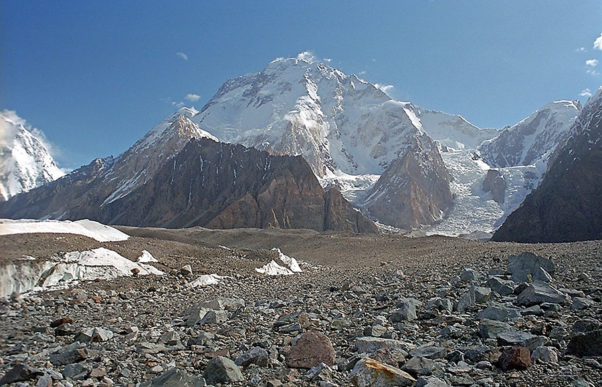
Once he learned how the thermals in the area worked, and became accustomed to the weather conditions there, the Frenchman hatched a plan. Climbing up to the Baltoro Glacier, he camped for a couple of nights while he made his preparations. On July 23, he took flight, gliding over the famous Trango Tower on his way to Concordia, a place where few paragliders have ever flown before. From there, he could see Nanga Parbat, K2, and Broad Peak.
After he got the lay of the land, Antoine was ready to go for it. He climbed above 6500 meters (21,325 ft), then set off in his paraglider. Catching thermals he was able to rise higher and higher, eventually reaching the summit of Broad Peak itself, which sits at 8051 meters (26,414 ft). This makes him the first person to actually fly to the summit of an 8000 meter peak in this manner.
Antonie is currently in transit back to France, but we're told that he has GoPro footage of the flight. You can bet that we're eagerly waiting to see how that turns out. It should definitely be very interesting. In the mean time, you can read all about his adventure here.

In a press release sent out this morning, Jornet says that he'll be making the climb throughout August and September. But prior to leaving for the Himalaya, he'll first begin to acclimatize in the Alps closer to home. For the next few weeks, Kilian and his support team will live and train in the European mountains as they begin to get their bodies ready for the demands that they'll face once they head to Tibet.
The plan is to attempt to summit Everest from the North Side, along a route that sees little traffic. The exact route hasn't been made clear yet, as the intention is to scout the mountain once they are there. What they find on the slopes of the mountain will ultimately decide which way he will go to the top.
The final summit push will begin at Rongbuk monastery and will continue all the way to the top of Everest, and then back down again. In all, Kilian will have to run about 30 km (18.6 miles), which is a short distance for a man who is use to competing in 100 mile (160 km) long races. But, he has never tested himself at such high altitudes before, so it is unclear how his body will respond. This will be the Spaniard's first attempt at an 8000-meter peak, but despite that he still intends to have a go at the FKT in alpine style and without the use of bottled oxygen.
Additionally, one has to wonder how much of an impact acclimatizing in the Alps will have on his progress. The highest peak in that mountain range is Mont Blanc, which stands 4810 m (15,781 ft) in height. That is not insignificant of course, but it is not even the same height as Base Camp on Everest. In other words, he'll still have a lot of work to do once he arrives in the Himalaya.
Right now, the plan is to depart Europe on August 7 to start the expedition. Kilian and his crew will then spend the next eight weeks prepping and planning for the run. Will he be able to set a new speed record on the highest mountain on the planet? Only time will tell, but I wouldn't doubt the man who set speed records on other mountains like Mont Blanc, Aconcagua, Denali, and Kilimanjaro. Still, Everest is an entirely different beast, and it will be interesting to watch this all unfold.
Stay tuned.
Rabu, 27 Juli 2016
I'll begin sharing the tale of my Mongolia adventure tomorrow, but in the meantime I wanted to share a sneak peek at what my journey was actually like. I traveled to the remote Asian country with my friends at Tusker Trail. For about two weeks I explored the Altai Tavn Bogd National Park on horseback and foot. To say that this was unlike any other travel experience that I have had before would be an understatement, but as you'll see in the clip below it was an incredibly rewarding experience, and one that you'll want to have on your bucket list too.
Yesterday I posted a story about the Solar Impulse aircraft completing its round-the-world journey using nothing but the rays of the sun to power the flight. Today, I have a great video that was captured by GoPro camera throughout the expedition. The short clip is a hyperlapse of final legs of the excursion, giving us some impressive views of the trip as seen from atop the plane itself. This was a wonderful achievement to say the least, and this video helps to put the accomplishment in perspective.

Konyukhov first set out on his journey back on July 12, taking to the air at 7:30 AM local time at a point located just north of Perth, Australia. He touched down just 11 days later in the town of Bonnie Rock, located in Western Australia at about 5:00 PM in the evening.
In completing the journey, the 64-year old Russian becomes just one of four people to successfully circumnavigate the globe in a balloon. He is the second to do so solo. Konyukhov circled the planet in a carbon fiber pod that was not pressurized, as he cruised along at speeds in excess of 150 miles (240 km) per hour, at an altitude that often reached to 30,000 feet (9144 meters). His speed record is two days faster than the previous mark, which was set by Steve Fossett back in 2002.
This latest achievement is just one of many for the Russian, who has scaled Everest twice, climbed the rest of the Seven Summits, and has skied to both the North and South Pole. He has even visited the Pole of Inaccessibility in the Arctic Ocean, and crossed the Pacific Ocean in a rowboat. An accomplished sailor, Konyukhov has sailed around the world four times, a skill that served him well in the balloon too.
Some of the challenges that he faced while flying around the globe in a balloon included bad weather, a frozen valve on his oxygen tanks, and a storm that froze over the balloon, adding enough additional weight that the flight was in serious jeopardy for a time. At one point, he even strayed far enough south that he was nearing Antarctica, just as his onboard heater was struggling to continue working. This put him into "survival mode" as he strayed into serious jeopardy for a time. Thankfully, he was able to overcome all of those obstacles, stay in the air, and still set the new speed record.
Congrats to Fedor on such an impressive accomplishment. Truly a great adventure for the modern age.

While the current state of adventure racing is very different from what it was a decade ago, I'd venture to say that the sport is as healthy now as it has ever been, which much of the credit for that going to the ARWS. If you're looking for further proof of this, one only needs to look to the recent announcement that adventure racing is coming to China this September in the form of the Xtrail Expedition Race.
For now, the Xtrail is operating as a demonstration event for the ARWS, but it is the first officially sanctioned race to be held in Asia. The event will be held in the remote Altay region of the Xinjiang province, in far northwestern China. It will feature the usual disciplines of mountain biking, kayaking, and trail running, all set in a place unlike any most of the competitors have seen before.
In order to lure teams to the event, the organizers of the Xtrail are offering a number of great incentives. Those include a reduced price entry fee of $1,000 USD per team, free transfers to/from Urumqi (arrival city) to Altay (race city), all accommodations and some food in Altay, and a $600 USD cash payment per international athlete on arrival to assist with travel expenses in China. In other words, they are serious about attacking top teams and want to make the process has simple and painless as possible.
Entry into the race is listed to just 25 international teams and 25 Chinese teams, so if you're interested in joining in on the fun, you'll want to sign up soon. The Xtrail will take place on September 23-28, and will cover roughly 300 km (186 miles). Need further incentive? The prize purse for the event is expected to top out at $50,000 USD.
Find out more at the ARWS website.

The list of high points across the U.S. is quite diverse. At one end of the spectrum you have Britton Hill in Florida, which is a mere 345 feet (105 meters) above sea level and barely a challenge at all. On the other hand, Denali in Alaska is a stunning 20,308 ft (6189 meters), and a true mountaineering challenge. In between you'll find all kinds of other mountains and hills, most of which are mere walk-ups. Still, nabbing all of them in under 50 days remains a significant achievement in no small part because of the travel time involved.
Melissa and Maddie began their challenge by summiting Denali earlier this spring, and have now been slowly but surely ticking off the other high points as they go. At this point, they've now reached the highest elevation in 43 different states, with Wyoming, Utah, Nevada, California, Oregon, Washington, and Hawaii yet to go. Each of the mountains in those states are above 10,000 feet (3048 meters), which means they will all present a unique challenge. But, considering the resumes that these two ladies bring to the table, they should certainly not have too much of a problem claiming them all.
You can follow their progress on Melissa's website as they close in on the end. Check out the video below for a preview of the challenge as well.


